ZTmail Exploration Part 8:
Security + Cryptography: Building the Global Email Security Ecosystem
September 23, 2026
A school recently warned parents to verify that an email was really from the school by checking the sender’s domain. It is a reasonable precaution, but it exposes a deeper problem: the information recipients see in an email is not, by itself, proof of who actually sent the message.
Email has sophisticated security systems, trusted domains, authentication mechanisms, and layers of threat detection, yet recipients are still often asked to make the final judgment themselves. If the infrastructure around email is already so mature, why does establishing cryptographic trust still require so much specialized effort, and where exactly is the gap?
1. Email Security Is an Ecosystem Problem
Email Security is often presented as a product problem: install a gateway, configure a certificate, enable encryption, and the job is done. At enterprise scale, the reality is different, because email is not a single application but a chain of services, products, identities, trust relationships and specialized systems that have evolved over decades and now operate across organizational and national boundaries.
S/MIME has provided the underlying cryptographic model for decades: certificates can bind identities to public keys, digital signatures can provide integrity and sender’s identity, and encryption can protect message contents. The challenge is therefore less about whether technology exists than about how to make the complete certificate lifecycle practical across the infrastructure that already carries global email, without forcing every participant to rebuild the functions it already provides.
That makes Email Security an ecosystem problem rather than simply a product problem. The relevant question is not which existing system should be replaced, but how cryptographic capabilities can become a dependable part of the systems and workflows that already work, so that security, trust, delivery and cryptographic protection can operate as one coordinated process.
2. Everyone Is Already Good at Something
The existing email ecosystem already contains mature specialists, each of which has spent years developing capabilities around a particular part of the overall workflow. Email platforms deliver and store messages; security vendors inspect and protect them; certificate authorities validate identities and issue certificates within their trust frameworks; email clients provide user experience; and cloud and AI platforms provide applications, infrastructure and analysis.
None of these roles need to disappear for email cryptography to become easier to deploy. A security vendor does not need to become a certificate authority, and a certificate authority does not need to become an email security platform. An email provider does not need to rebuild its IT infrastructure, while an AI service does not need to become a cryptographic system simply because cryptography has become an increasingly important part of trusted communication.
The missing capability is the operational connection between these existing capabilities and everyday email: the mechanism that can take certificates and trust, connect them with keys and cryptographic operations, and make the resulting functions available inside the email workflows that users and organizations already depend on.
3. When Encryption Becomes a Security Problem
There is an architectural tension at the heart of Email Security. Security systems need sufficient access to messages to inspect, classify and enforce policy, while message-level encryption is specifically designed to ensure that only authorized recipients can access protected content. The two objectives are both legitimate, but they cannot be treated as independent features if an organization wants them to operate together.
The very technology that improves confidentiality can therefore reduce the visibility that security systems need to protect the message. This is not an argument against encryption; it is an integration problem that becomes more significant as organizations add more layers of security inspection, policy enforcement and automated analysis.
Practical architecture must allow security inspection and cryptographic protection to coexist within a controlled workflow. An inbound message may need to be decrypted under appropriate organizational controls, inspected by the existing security stack, and then delivered according to policy; on outbound email, security inspection can occur before the message is digitally signed and, where required, encrypted for its recipients. In both directions, the objective is to preserve the strengths of both systems rather than forcing one capability to compromise the other.
The goal, therefore, is not to make security systems see less, nor to weaken cryptographic protection for the sake of inspection, but to make cryptographic protection and security inspection work together as coordinated parts of the same email infrastructure.
4. The Missing Capability: Cryptographic Application Automation
This is where a dedicated cryptographic application layer becomes important. Its job is not to become the mail server, the anti-malware engine, the DLP platform or the AI model; instead, its purpose is to make cryptography usable inside those existing workflows and to connect cryptographic operations with the applications and infrastructure in which email already operates.
That includes certificate enrollment and renewal, certificate selection, key protection, signing, encryption, decryption, identity presentation and lifecycle management, but the deeper value lies in coordinating these functions so that they do not remain isolated administrative tasks. When these operations are automated and connected to the application workflow, cryptography can become part of normal email behavior rather than a separate project that users and administrators must manage manually.
The certificate exists. The security stack exists. What is missing is the automation that makes them work together, because a certificate by itself does not automatically place a usable cryptographic identity into an email client, protect the associated keys, apply the correct certificate to a message, or manage the lifecycle that follows.
This is fundamentally different from being a CA or a security vendor. The purpose is not to replace either; it is to make their capabilities work together efficiently, while allowing each participant to remain focused on the part of the ecosystem in which it has the greatest expertise.
5. Security + Cryptography: Two Capabilities, One Workflow
Security and cryptography address different parts of the trust problem. Security systems detect threats, inspect content, enforce policy and respond to suspicious activity, while cryptography provides mechanisms for verifiable identity, message integrity and confidentiality. Treating them as competing layers creates an unnecessary architectural choice when they can instead be coordinated within the same workflow.
They are therefore complementary rather than competing functions. A cryptographic gateway can sit alongside an existing email security gateway, with each performing the work for which it was designed, while an organization retains its existing security policies and inspection capabilities instead of creating a parallel security stack merely to introduce S/MIME.
A representative inbound workflow is: Encrypted Email In → Cryptographic Gateway → Controlled Decryption → Existing Security Stack → Inspect / Detect / Enforce → Email Client. For outbound mail, the sequence can be: Email Client → Security Inspection → Cryptographic Gateway → Signed and/or Encrypted Email Out. If confidentiality is not required, the message can be digitally signed and associated with a trusted identity; where confidentiality is required, it can be signed and encrypted before delivery.
This architecture also shows how important collaboration is. Cryptographic identity does not eliminate accounts compromised, private keys stolen or malicious insiders, because cryptography cannot by itself remove every attack path. What changes is that sender identity and message integrity can become cryptographically verifiable rather than relying only on visible claims and content-based signals, adding a distinct trust signal to the broader security model.
6. The Missing Industry Role: Cryptographic Application Automation Provider
Once the problem is viewed as an ecosystem problem, a distinct industry role becomes visible: the Cryptographic Application Automation Provider (CAAP). This role exists because the industry already has certificate authorities, security vendors, email platforms, clients and cryptographic technologies, but those capabilities do not automatically become one operational workflow simply because each component exists.
Certificate authorities already provide certificates and trust. Security vendors already provide security. Email providers already provide email infrastructure. Clients already provide the interface through which users send and receive messages. The missing role is the provider that connects these capabilities and automates the cryptographic application lifecycle, turning certificate-based trust and cryptographic functions into something that can participate directly in everyday email operations.
A CAAP can connect certificate services, trust, keys, cryptographic operations, email infrastructure and security workflows, allowing each participant to contribute what it already does best instead of requiring every participant to develop an overlapping set of capabilities. It is an integration and automation role with a clear architectural purpose, rather than another attempt to consolidate the entire email security stack.
The principle is simple: each related provider does what it does best. CAAP makes the pieces work together, so that the ecosystem can deliver a capability that would be difficult for any single participant to provide efficiently on its own.
7. Standards Make the Ecosystem Interoperable
An ecosystem needs more than individual capabilities. It needs a common way for those capabilities to work together, because without a shared technical model every connection becomes a proprietary integration that must be designed, implemented and maintained separately. This is where standards become powerful: they provide common rules that allow independently developed components to participate in the same technical process.
RFC 8823, published by the IETF, extends ACME (RFC 8555) for end-user S/MIME certificates. It defines the use of an email identifier and an email-based challenge mechanism, and it explicitly considers ACME-aware mail user agents. In practical terms, it provides a standardized path for email applications to participate in automated S/MIME certificate workflows rather than treating certificate enrollment as an entirely separate manual process.
The significance of RFC 8823 is not that it creates another certificate technology. It creates a common technical language through which email applications, certificate automation services and trust providers can participate in automation, making it possible for different vendors to implement compatible pieces without having to negotiate a unique protocol for every relationship.
This is why standards matter to the ecosystem. With proprietary interfaces, the industry can produce capable products but still struggle to connect them efficiently; with open standards, different vendors can implement compatible components, build integrations around the same technical foundation, and allow the ecosystem to expand beyond a single product or provider.
Standards define the path. Automation makes the path usable.
8. ZTmail: Turning the Standard into a Working Ecosystem
ZTmail positions itself as a Cryptographic Application Automation Provider, its system is designed to demonstrate what above model looks like when the pieces are connected end to end. ZTmail App brings S/MIME automation into the user workflow, while the ZTmail S/MIME Automation Gateway extends cryptographic automation into organization infrastructure; certificate automation services and trust infrastructure connect certificate issuance and lifecycle operations to those applications, creating a complete implementation in which the major functions can operate as a coordinated process.

The important point is not that ZTmail must own every component. The point is that the complete workflow can be made operational: identity and certificates can be obtained through automated processes; keys and cryptographic operations can be managed within the appropriate infrastructure; and messages can be signed, signature validation, encrypted, decrypted and presented with trusted identity as part of normal email operations rather than as a collection of separate administrative procedures.
In this sense, ZTmail is not trying to become another email platform, another security stack or another CA. It is implementing the role of a Cryptographic Application Automation Provider, a CAAP, and demonstrating how existing capabilities can be connected through open standards, so that the industry can see not merely a collection of technologies, but a working model of how those technologies can cooperate.
ZTmail built the model end to end because an ecosystem is easier to build when there is a working implementation that can demonstrate the complete path, provide a basis for integration, and show other participants where their own capabilities can connect. The purpose of building the first complete model is therefore not to close the ecosystem, but to make the ecosystem easier for others to join.
9. From One Working Model to an Open Industry Ecosystem
A successful ecosystem should not depend on one vendor, because the objective is not to create another proprietary island inside email but to establish a model that more participants can implement, integrate with and extend. Once the model is proven, the natural next step is to invite more participants to build it together, using the same standards as the common technical foundation.
Other CAAPs can offer their own implementations and services. Other email clients can add ACME and RFC 8823 support. Other cryptographic technology providers can develop S/MIME Automation Gateways. Certificate authorities can continue to provide certificate and trust services with ACME service for S/MIME certificates, while security vendors can integrate cryptographic workflows with their existing inspection and policy capabilities, allowing the ecosystem to grow through specialization rather than consolidation.
This is the power of an open standard: the ecosystem can grow through participation rather than through a single proprietary architecture. As more independent participants implement compatible technologies, the number of possible integrations can grow, deployment choices can diversify, and organizations can increasingly adopt Email Security without having to depend on one provider to provide every component.
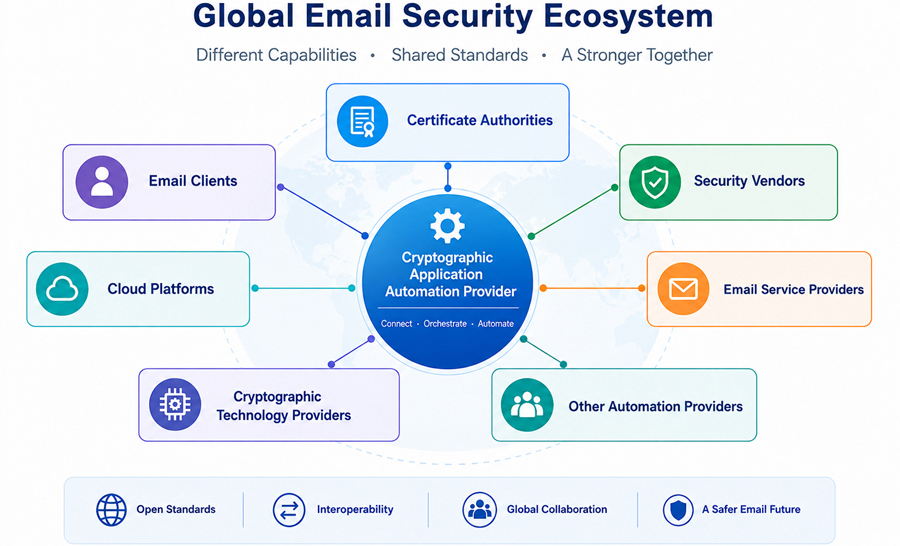
ZTmail’s role is therefore not to own the ecosystem. It is to help build the stage, demonstrate that the pieces can work together, and invite the broader industry to join the effort. The first complete implementation is proof of the model; the larger objective is to make the model available for an industry to build upon.
10. An Invitation to Build the Future of Email Security
S/MIME does not need to remain a specialized capability available only to organizations with the resources to manage certificates, keys, clients and cryptographic infrastructure manually. Technology exists, the standards exist, and the industry already possesses most of the specialized capabilities required to support Email Security; what is needed now is to connect those capabilities, automate the operational work, and make the resulting model practical at global scale.
That requires collaboration across the industry. Email client vendors can make cryptography part of the user experience; certificate authorities can provide identity and trust with ACME capacity; security companies can enhance their ability to detect, inspect and defend by incorporating the trust signal; cryptographic technology providers can build secure cryptographic infrastructure; email and cloud platforms can provide email encryption automation services within their platforms; and Cryptographic Application Automation Providers can connect these capabilities and turn them into operational workflows.
ZTmail has built an end-to-end implementation to demonstrate how this ecosystem can operate in practice, following the standards and connecting the roles that already exist across the industry. The next step is bigger than any single product or company: invite more participants to implement the standards, connect their capabilities, develop compatible products and services, and collectively make cryptography automatic for email users and organizations.
The goal is not to make ZTmail the ecosystem. The goal is to build an ecosystem in which the entire industry can participate, contribute its own expertise, and help expand the practical reach of Email Security.
This is ultimately about more than one product, one company or one market. It is about completing the transition from S/MIME as a technically mature capability to S/MIME as a broadly accessible part of global email infrastructure, so that strong cryptographic identity, integrity and confidentiality can become available wherever email is used.
Together, the industry can turn S/MIME from a proven technology into a universally accessible capability of email, making secure, trusted email a practical reality for people and organizations around the world.
Click here to read PDF edition (digital signature and timestamp with global trust and global legal effect, all rights reserved, plagiarism is prohibited! Please indicate when reprinting: Reprinted from ZoTrus CEO Blog)